A greenhouse can move from comfortable to dangerously hot during a short period of direct sunlight. The opposite problem often develops after sunset, when the air cools, relative humidity rises, and moisture begins collecting on colder leaves and structural surfaces.
Automated ventilation helps the greenhouse respond while these changes are happening. Vents, louvers, exhaust fans, circulation fans, shading, heating, and cooling equipment can be coordinated by sensors instead of depending entirely on someone being present to open a window.
The purpose is not to maintain one perfect temperature or humidity reading. It is to keep the crop within a manageable climate range while preventing abrupt drafts, stagnant pockets, condensation, equipment conflicts, and unnoticed failures.
Ventilation Has Several Jobs
Greenhouse ventilation is often described only as a way to remove heat. Temperature control is important, but the system also influences humidity, gas concentration, air distribution, leaf temperature, and the environment experienced inside the plant canopy.
Ventilation cannot compensate for every growing problem. Excessive plant density, water on the floor, leaking irrigation, poorly timed watering, blocked walkways, unhealthy plants, dirty glazing, or unsuitable crop spacing can continue creating humidity and temperature problems even when the fans operate correctly.
Air Exchange and Air Circulation Are Not the Same
Air Exchange
Air exchange moves greenhouse air outside and brings replacement air into the structure. Roof vents, side vents, intake louvers, exhaust fans, open walls, and doors can all contribute.
This process can remove heat and moisture when the outdoor air offers useful ventilation conditions.
Internal Circulation
Circulation fans move air around the closed greenhouse without necessarily replacing it with outdoor air. Their purpose is to mix temperature, humidity, heat, and gases more evenly.
A circulation fan cannot remove accumulated heat or moisture from a sealed greenhouse by itself.
Why the Difference Matters
A grower may see leaves moving and assume the greenhouse is ventilated. If no air is leaving the structure, heat and water vapor may continue accumulating.
The opposite mistake also occurs. A large exhaust fan may replace air rapidly while leaving sheltered sections of the canopy with weak circulation. Successful control requires both a route through the greenhouse and reasonable air movement around the plants.
Choose the Ventilation Architecture Before Programming It
Warm air rises and exits through roof or ridge openings while replacement air enters through sidewall or lower openings. Wind passing over the greenhouse can strengthen this exchange.
Natural ventilation can use motorized vents, roll-up sides, automatic thermal openers, or a combination. Performance depends strongly on vent area, greenhouse width, wind, structural design, insect screens, surrounding buildings, and outdoor temperature.
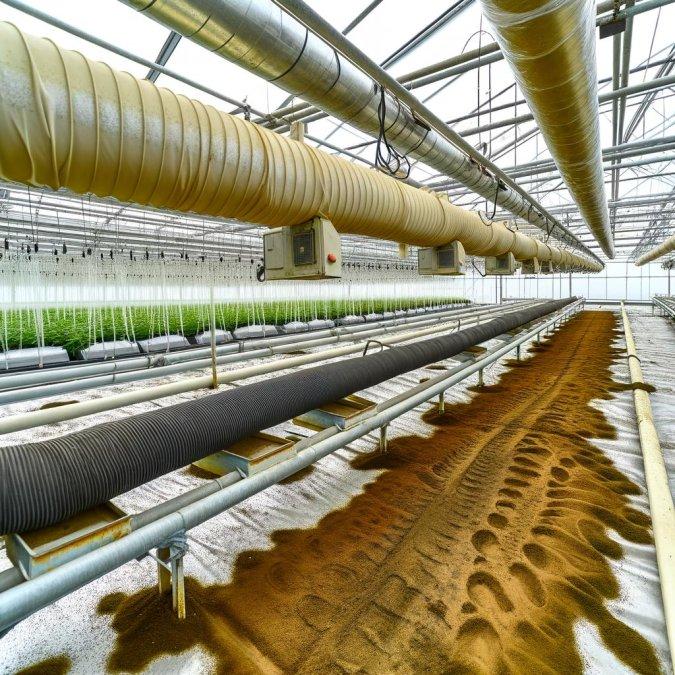
Exhaust fans create a pressure difference that draws replacement air through planned intake openings or cooling pads.
This approach provides more predictable airflow than relying only on wind, but fan capacity, intake area, static pressure, shutters, screens, greenhouse length, and equipment placement must be considered together.
A hybrid greenhouse uses natural ventilation when outdoor conditions and wind are favorable, then adds mechanical ventilation, shading, or evaporative cooling when natural exchange is insufficient.
The controller must prevent incompatible components from fighting one another or operating when another strategy would be more effective.
Small greenhouses may use temperature-sensitive hydraulic or wax-filled vent openers that operate without household electricity.
These devices can provide useful basic protection during a power interruption, but they do not monitor humidity, wind, rain, equipment position, or separate crop zones.
The correct architecture depends on climate, greenhouse construction, crop value, crop height, season, local wind, available power, maintenance capacity, and how severe the consequence of a failure would be.
The Greenhouse Behaves Differently During the Day and at Night
During Bright Daylight
Solar radiation can raise greenhouse temperature rapidly even when the outdoor air feels mild.
- Roof and side vents may open progressively as heat develops.
- Mechanical exhaust may be added when natural ventilation cannot hold the desired range.
- Shade may reduce the heat load before larger fans or cooling equipment are required.
- Evaporative cooling may help where outdoor air is dry enough to absorb additional moisture.
- The controller should watch wind and rain before moving vulnerable roof vents.
After Sunset
Air temperature falls, the relative humidity often rises, and leaves or glazing may cool enough for condensation to develop.
- Circulation can reduce cold and humid pockets while the structure remains closed.
- Watering late in the day may add moisture that becomes difficult to remove overnight.
- Brief heating and ventilation cycles may be used in some climates to remove moist air without leaving the greenhouse continuously open.
- The crop and structure should be checked for dripping condensation and wet foliage.
- Cold-air entry must not create damaging drafts across sensitive plants.
Day and night setpoints should not be copied from another greenhouse without considering crop species, plant stage, greenhouse construction, season, light level, heating system, disease risk, and outdoor conditions.
Sensor Placement Determines What the Controller Believes
An automated system can follow its programming perfectly and still create poor conditions when the measurements do not represent the crop.
Position the sensor where it reflects the air surrounding the crop rather than direct sunlight, a heater discharge, roof heat, a cold wall, or the exhaust stream.
Protect the sensor from irrigation spray and condensation while keeping it within representative moving air. A wet sensor enclosure can create misleading readings.
Outside temperature and humidity help the controller determine whether ventilation can actually cool or dry the greenhouse.
Weather sensors can protect motorized vents and modify control strategies during strong wind or rainfall.
Feedback switches or position sensors can verify whether a vent, louver, curtain, or shade system physically reached the commanded position.
Long houses, separate bays, dense crops, partitioned areas, cooling-pad ends, fan ends, and different crop heights may require more than one environmental measurement point.
Use radiation shields or aspirated sensor housings when specified for the installation. Record the sensor location and compare its reading with a separate instrument during commissioning and seasonal maintenance.
Control Logic Should Use Ranges Rather Than One Trigger
A single thermostat that starts a large fan at one exact temperature can produce repeated starting and stopping as the reading moves slightly above and below the trigger.
Better control usually stages responses and includes a reasonable deadband or delay. The exact settings must be chosen for the greenhouse and crop.
Stable Conditions
Essential circulation and monitoring continue while vents and exhaust equipment remain in their normal low-demand condition.
Moderate Heat
Shade, roof vents, side vents, or a lower ventilation stage can begin before the greenhouse reaches an emergency condition.
High Heat
Additional vent opening, exhaust capacity, cooling pads, fogging, or other approved cooling equipment may be activated.
Excess Moisture
The controller may combine circulation, controlled ventilation, heating, irrigation changes, or dehumidification according to outdoor conditions and crop needs.
Adverse Weather
Roof vents may be limited or closed during strong wind or heavy rain while another safe ventilation route is used.
Equipment Fault
The system should report the failure, move to a defined safe state when possible, and allow manual intervention.
Minimum run times, minimum rest periods, gradual vent movement, separate stages, and alarm delays can reduce unnecessary cycling. Delays should not be so long that dangerous heat or equipment failure goes unnoticed.
Humidity Control Is Really Condensation Control
Relative humidity changes when temperature changes, even when the actual amount of water vapor in the air remains similar. Cooler air reaches saturation more easily than warm air.
Condensation forms when a leaf, pipe, glazing panel, or another surface falls below the dew-point temperature of the surrounding air. This means a greenhouse can report an acceptable average air temperature while colder leaves or structural areas remain wet.
What Helps Reduce Condensation Risk
Gentle circulation can reduce isolated cool and humid pockets around leaves.
Repair leaks, drain floors, manage irrigation, remove standing water, and avoid unnecessary late watering.
Replacing humid indoor air is useful when the incoming air has meaningful drying potential.
Heating, insulation, energy curtains, airflow, and greenhouse maintenance can reduce areas where moisture condenses.
Dense foliage slows air movement and increases the amount of water vapor released into a restricted canopy.
Nighttime peaks and early-morning condensation may be missed by occasional manual checks.
High humidity does not prove that disease is present, and ventilation does not cure an infected plant.
Moisture and leaf wetness can make conditions more favorable for several greenhouse diseases, but reliable disease management still requires sanitation, plant inspection, correct diagnosis, healthy planting material, appropriate spacing, and crop-specific management.
Horizontal Airflow Fans Need a Defined Purpose
Horizontal airflow fans are commonly used to establish a gentle circulation pattern through a closed greenhouse. They can help distribute heat, reduce temperature differences, mix air, and limit cold locations where condensation develops.
The fans should not produce a harsh draft that bends young plants continuously or dries one part of the crop much faster than another.
The interaction between circulation fans and open natural vents must also be considered. Purdue Extension notes that horizontal airflow fans can redistribute hot roof air downward while natural ventilation is trying to let that air rise and escape. UMass guidance similarly describes switching circulation fans off when the main ventilation system activates in suitable designs.
- Confirm whether the circulation pattern forms a complete loop rather than opposing fan streams.
- Keep benches, hanging baskets, screens, curtains, and mature foliage from blocking the intended path.
- Observe leaves throughout the greenhouse rather than only beside the fan.
- Coordinate fan operation with roof vents, side vents, exhaust fans, heaters, and energy curtains.
- Clean blades and guards because dirt reduces performance and can unbalance the fan.
- Follow the greenhouse designer’s or equipment supplier’s layout rather than positioning fans by convenience alone.
Exhaust Capacity and Intake Area Must Be Balanced
A large exhaust fan cannot deliver its rated airflow if replacement air cannot enter easily. Restricted louvers, dirty cooling pads, insect screens, narrow openings, nearby walls, crop blockage, and high static pressure can substantially reduce actual performance.
University extension publications provide useful starting rules for greenhouse airflow, but they should not be treated as universal engineering specifications. Greenhouse width, length, height, crop resistance, screens, pad systems, local climate, elevation, static pressure, wind, and desired temperature difference all affect the final design.
For valuable crops or larger structures, obtain sizing assistance from a greenhouse equipment supplier, agricultural engineer, or another qualified professional.
Ventilation Works Better When Heat Is Reduced Before It Enters
Evaporative equipment adds moisture and therefore must be coordinated with ventilation and crop needs. It also requires clean water, pump maintenance, pad inspection, drainage, and protection against mineral buildup and biological growth.
Ventilation and Carbon Dioxide Affect Each Other
Fresh Air Restores Ambient CO₂
Plants can reduce greenhouse carbon-dioxide concentration during active photosynthesis when the structure remains closed. Ventilation brings outside air into the greenhouse and helps restore ambient CO₂ while circulation distributes it through the crop.
A greenhouse using supplemental CO₂ needs coordinated control because opening vents can release the added gas outdoors. Enrichment equipment should not operate independently of ventilation, combustion safety, heating, lighting, and gas monitoring.
Fuel-fired CO₂ generation can introduce heat, moisture, carbon monoxide, ethylene, nitrogen oxides, or other harmful combustion products when equipment or ventilation is unsuitable. Use approved equipment and professional installation.
Automation Needs a Failure Plan
Independent Alarm
A high-temperature, low-temperature, power-loss, communication, or equipment alarm should reach a responsible person through a dependable route.
Manual Operation
Staff should know how to open vents, operate fans, isolate equipment, or restore a safe basic setting without depending entirely on the main application.
Local Control
Essential protection should continue locally when internet access, a cloud service, or remote monitoring becomes unavailable.
- Power failure: fans, vent motors, pumps, sensors, routers, and alarms may stop at the same time unless backup systems are planned.
- Vent actuator failure: the controller may command an opening that never occurs.
- Stuck intake shutter: exhaust fans may run with restricted replacement air.
- Sensor drift: automation may respond consistently to an inaccurate reading.
- Broken covering or open door: the intended airflow path and pressure balance can disappear.
- Network interruption: remote data can stop while the local controller continues operating normally.
- Heating and ventilation conflict: energy can be wasted when one system heats while another removes air without a planned humidity-control cycle.
- Water-supply failure: evaporative pads or fogging equipment may run dry or lose cooling capacity.
- Wind event: open roof vents can be damaged when weather protection is absent or incorrectly configured.
Remote access is not the same as emergency protection. A dashboard can report a problem, but it cannot physically repair a broken vent, refill a cooling tank, restart a tripped circuit, or remove an obstruction.
Commission the System With Plants in Mind
Testing should occur before the hottest or coldest part of the season and should continue after the crop canopy changes.
- Compare controller readings with a separate reliable instrument.
- Confirm that each vent, curtain, louver, shade, and fan moves in the intended direction.
- Observe the complete opening and closing cycle rather than testing only a small movement.
- Verify that equipment-position feedback matches the physical position.
- Inspect air movement near crop height, entrances, walls, corners, pads, and fan ends.
- Confirm that alarms reach the correct people and contain enough information to guide a response.
- Test what happens when a sensor is disconnected or reports an unrealistic value.
- Check how the system recovers after a power interruption.
- Review whether wind and rain protection changes vent behavior correctly.
- Record the normal temperature and humidity pattern before changing several settings.
- Repeat airflow checks after plants become taller or denser.
Use Trend Logs to Find Problems Hidden by Averages
A daily average can make a greenhouse look stable while hiding a short period of dangerous heat or several hours of nighttime saturation.
Mechanical Maintenance Is Climate Maintenance
Inspect the Components That Change the Air
Clean blades, guards, housings, belts, pulleys, bearings, and motor surfaces according to equipment instructions.
Remove dirt and corrosion and confirm that every blade opens fully without sticking.
Inspect hinges, racks, gears, cables, seals, motors, limit switches, alignment, and storm damage.
Check for clogging, tears, loose edges, crop contact, and airflow resistance.
Clean housings, compare readings, replace damaged shields, and follow calibration or replacement guidance.
Inspect water distribution, pumps, filters, nozzles, mineral deposits, algae, drainage, and dry sections.
Service heaters and combustion systems before they are used for nighttime humidity management.
Test batteries, contacts, communication paths, generators, automatic transfer equipment, and emergency instructions.
A slightly restricted shutter or a slow vent motor may not produce a clear equipment alarm. The climate trend and crop response may reveal the loss of performance before the component fails completely.
Practical Strategies for a Small Greenhouse
Begin With Passive Protection
Provide functional roof and lower vents, suitable shade, and an automatic thermal opener where appropriate. Keep the openings free from stored tools and plant growth.
A passive vent can continue operating during an electrical outage, but it should not be the only protection where extreme temperatures can develop.
Add Mechanical Support Carefully
Use an appropriately sized exhaust fan and intake opening when passive ventilation cannot manage the heat load. Confirm that incoming air does not strike sensitive plants directly.
A separate circulation fan may help when the greenhouse is closed, especially during cooler and humid periods.
Use More Than One Thermometer
Compare canopy height with a warmer upper area and any cold location near glazing or the entrance. Large differences indicate that one reading does not describe the complete structure.
Plan for Absence
Use a dependable high-temperature alarm and arrange for someone to inspect the greenhouse when you cannot respond. Remote readings cannot replace local access during a mechanical failure.
Common Automation Mistakes
- Copying another grower’s setpoints: the crop, structure, climate, sensors, equipment, and production goals may be different.
- Using only one exposed sensor: direct sunlight or equipment airflow can make the controller react to an unrepresentative condition.
- Treating circulation as ventilation: moving humid air inside a closed house does not remove the moisture.
- Oversizing exhaust without improving intake: actual airflow remains restricted and excessive negative pressure may develop.
- Ignoring screens: insect screens can reduce natural and mechanical airflow substantially when their resistance is not considered.
- Running every system together: vents, exhaust, heaters, cooling pads, fogging, shade, and energy curtains need coordinated logic.
- Allowing rapid vent movement: large sudden openings can create drafts, temperature swings, and unnecessary actuator wear.
- Failing to verify vent position: software status may not match a twisted linkage or stuck physical opening.
- Using relative humidity alone: leaf temperature, dew point, outdoor conditions, irrigation, and canopy airflow also matter.
- Depending only on cloud access: essential protection may disappear during an internet or service outage.
- Never reviewing trend data: short heat spikes and overnight moisture problems remain hidden by averages.
- Skipping seasonal recommissioning: plant density, shade, wind, equipment resistance, and outdoor conditions change.
Frequently Asked Questions
Should greenhouse circulation fans run continuously?
Not automatically. Continuous low-speed circulation can be useful in a closed greenhouse, but fan operation should be coordinated with natural vents, exhaust systems, heating, curtains, crop sensitivity, and the intended airflow pattern. Follow the system design and verify conditions around the plants.
Can ventilation keep a greenhouse cooler than the outdoor air?
Air exchange alone generally moves greenhouse temperature toward the outdoor temperature while removing accumulated solar heat. Cooling below outdoor dry-bulb temperature usually requires evaporative cooling, refrigeration, or another active cooling method.
Why is the greenhouse still hot when the exhaust fan is running?
Possible causes include insufficient intake area, dirty shutters, blocked cooling pads, screens, undersized fans, high static pressure, air shortcuts, strong solar load, damaged covering, poor shade, or outdoor air that is already very hot.
Can an automatic roof vent replace an exhaust fan?
It may provide enough protection in a small, well-designed greenhouse under favorable weather. Wider structures, weak wind, small vent area, insect screens, extreme heat, or dense crops may require mechanical support.
Does high humidity always mean the vents should open?
No. The controller should consider indoor and outdoor temperature, outdoor moisture, wind, rain, heating demand, crop needs, and condensation risk. Venting with unsuitable outdoor air may provide little drying or may cool the crop too rapidly.
Where should the main temperature sensor be placed?
Place it within a representative crop environment and protect it from direct sunlight, heaters, cooling pads, exhaust streams, exterior walls, and irrigation. Larger or divided greenhouses may need several sensors.
Will airflow prevent fungal diseases?
Airflow and humidity management can reduce conditions favorable to some diseases, but they cannot guarantee prevention. Sanitation, healthy plants, irrigation practices, spacing, scouting, diagnosis, and crop-specific management remain necessary.
What should happen when the internet fails?
The local greenhouse controller should continue essential ventilation and safety logic whenever possible. Manual controls and independent alarms should remain available.
Automated ventilation is successful when the crop experiences a stable environment and the grower can explain why each component is operating.
Begin with a clear path for air to enter, move through the plants, and leave the greenhouse. Distinguish circulation from air exchange. Position sensors where they represent the crop, stage equipment gradually, and account for the outdoor air before trying to remove heat or moisture.
Then verify the physical result. Watch vents move, inspect shutters, observe leaves, compare several locations, review nighttime trends, and confirm that alarms reach someone capable of responding.
The best system is not the one with the most complex dashboard. It is the one that controls heat and moisture consistently, fails predictably, and can still be operated safely when a sensor, actuator, network, or power source becomes unavailable.
Sources and Further Reading
- Purdue University Extension: Temperature Control in Greenhouses
- UMass Extension: Ventilation for Greenhouses
- UMass Extension: Reducing Humidity in the Greenhouse
- UMass Extension: Horizontal Air Flow for Greenhouse Circulation
- University of Florida IFAS Extension: Greenhouse Ventilation
- Oklahoma State University Extension: The Hobby Greenhouse
- University of Connecticut Extension: Reducing Greenhouse Humidity
- Penn State Extension: Sources of Plant Disease in Greenhouses
- Oklahoma State University Extension: Greenhouse Carbon Dioxide Supplementation

The BotaniQ Editorial Team writes and maintains practical guides about indoor gardening, smart irrigation, plant care, garden automation, and growing technology. Where relevant, articles reference official documentation, university extension resources, and other reputable sources. Content is updated when material information changes.