Year-round herbs do not begin with the strongest grow light available. They begin with a shelf, counter, or indoor garden where light reaches the entire plant canopy consistently.
An LED fixture can compensate for short winter days and weak windows, but it cannot correct waterlogged roots, crowded containers, unsuitable temperatures, exhausted plants, or a harvest routine that removes too much growth at once.
The aim is not to force the fastest possible growth. It is to maintain compact, healthy herbs that can be harvested repeatedly without turning the indoor setup into a difficult full-time project.
A dependable herb garden balances light intensity, daily light duration, fixture distance, plant spacing, water, and harvesting.
Changing only the lamp rarely solves a problem unless the rest of the growing conditions support the plant.
What an LED Grow Light Can and Cannot Do
It Can Extend the Season
Artificial lighting allows herbs to continue growing when natural indoor light is too weak or too brief, particularly during winter.
It Can Improve Consistency
A timer provides a repeatable light period, while an adjustable fixture can remain at a suitable distance as the plants grow.
It Cannot Replace Plant Care
Drainage, watering, airflow, pruning, temperature, pest inspection, nutrients, and root space remain essential.
The phrase “advanced LED technology” is often used as a marketing term. For a home herb garden, useful improvements are straightforward: even coverage, adjustable height, a dependable timer, reasonable energy use, manageable heat, and replaceable or serviceable components.
Intensity, Distance, and Duration Work Together
A plant does not respond to the product description on the light fixture. It responds to the light that actually reaches its leaves over the course of the day.
Watts, Lumens, PPF, and PPFD
Watts describe electrical energy use, not the exact light intensity received by the plant. A more efficient fixture can produce more useful light while consuming fewer watts.
Lumens describe brightness as perceived by human vision. PPF describes the plant-usable light emitted by a fixture, while PPFD describes how much of that light reaches a surface such as the leaf canopy.
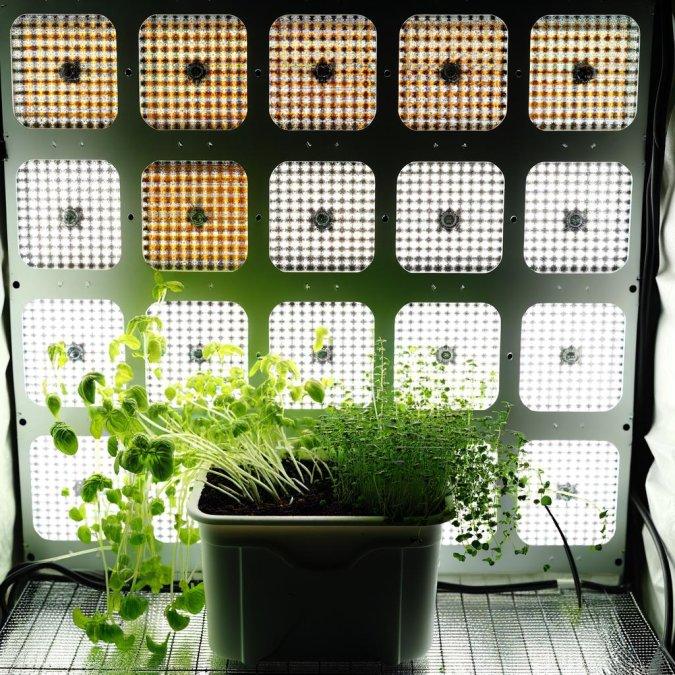
When manufacturers provide a coverage map or PPFD information at different heights, it is generally more useful for comparing grow lights than wattage alone.
A Practical Daily Light Schedule
There is no single timer setting for every herb, fixture, shelf, and window. Light duration must be considered together with intensity.
University of Minnesota Extension lists approximately twelve to fourteen hours of daily artificial light as a practical range for hydroponic lettuce and herbs. Other extension guidance recommends a longer supplemental period for potted herbs during weak winter daylight.
A sensible starting point is to:
- Follow the fixture and indoor-garden manufacturer’s guidance first.
- Use a timer so the schedule remains consistent.
- Include a regular dark period instead of leaving the lights on continuously.
- Count natural window light as part of the total daily exposure.
- Change intensity, distance, or duration gradually rather than adjusting everything at once.
- Observe new growth for several days before deciding whether the change helped.
Longer lighting does not automatically compensate for a weak or uneven fixture. A lamp that misses the edges of the canopy may produce tall central plants and weak outer plants even when it operates for many hours.
Balanced White Light Is a Practical Home Choice
Plants use several parts of the light spectrum. Red and blue wavelengths are important for photosynthesis, but a fixture that emits only strong red and blue light is not required for a small culinary herb garden.
White or mixed-spectrum LED fixtures are suitable for many plants and make leaf color, pests, nutrient symptoms, and harvest condition easier for people to inspect.
A “full-spectrum” label does not guarantee good performance. Coverage, output at the canopy, distance, reliability, heat management, and the size of the growing area remain more important than the marketing name.
Match the Herbs to the Shelf
Different herbs respond differently to indoor conditions. Grouping them by growth habit and water preference is usually more effective than arranging them only by appearance.
Choose Between Containers and Hydroponics
Traditional Indoor Containers
Containers should have drainage holes and a growing medium that drains while retaining enough moisture for the herb.
They provide flexibility because each plant can receive a different watering routine. They also make repotting, root inspection, and separating incompatible herbs easier.
Indoor Hydroponic Systems
Hydroponic gardens can grow herbs throughout the year in a compact area, but they require a clean reservoir, suitable nutrients, dependable lighting, water monitoring, and regular maintenance.
Herbs and leafy greens are usually more practical indoor hydroponic crops than large fruiting plants because they require less time, space, heat, and light.
A strong LED does not remove the need for adequate root space. When potted herbs become root-bound or hydroponic roots block water circulation, growth can decline even while the light remains unchanged.
Read the Plant Before Moving the Lamp
Visible changes are useful clues, but they are not complete diagnoses. Light problems can resemble water, temperature, pest, root, or nutrient problems.
The light may be too weak, too far away, unevenly distributed, or available for too little time.
One side may receive stronger window or fixture light. Rotate individual pots or improve fixture coverage.
The fixture may be too close or warm, but root problems, nutrients, disease, and watering should also be checked.
The advertised coverage area may be larger than the area receiving useful light at the current height.
The canopy may need pruning and better airflow rather than more light.
The plant may need more recovery time, root space, suitable nutrition, or replacement rather than a stronger lamp.
Change one factor at a time. Moving the light, extending the timer, adding fertilizer, changing the water, and pruning heavily on the same day makes it difficult to understand what caused the result.
Watering Under LEDs
Indoor lighting can increase growth and water use, but watering should still respond to the root zone rather than the timer.
- Use containers with functional drainage holes.
- Check moisture below the surface instead of watering because the top looks dry.
- Water thoroughly when needed and allow excess water to drain.
- Do not allow containers to remain in standing runoff.
- Let thyme, oregano, sage, rosemary, bay, and marjoram dry more between waterings than moisture-loving herbs.
- Expect water use to increase as roots and leaves become larger.
- Keep water away from plugs, timers, power supplies, and electrical connectors.
Constantly wet growing medium encourages root problems, particularly during cooler indoor periods when plants use water more slowly.
Harvest in a Way That Leaves the Plant Productive
Continuous Harvest Depends on What Remains
Cut above a healthy pair of leaves so side shoots can continue developing.
Cut leaves above the base and avoid damaging the growing point.
Remove individual outer stalks near the base while preserving younger central growth.
Take modest stem tips and avoid cutting deeply into old leafless wood.
Frequent light harvesting can encourage branching in suitable herbs. Removing most of the foliage at once reduces the leaf area available for recovery.
Annual herbs will not remain equally productive forever. Basil, cilantro, and dill may eventually flower, decline, or need replacement. Year-round harvesting often depends on restarting selected plants rather than preserving one specimen indefinitely.
A Simple Rhythm for the Herb Shelf
For hydroponic units, also follow the reservoir, nutrient, pump, and sanitation schedule specified by the manufacturer. Our guide to maintaining an indoor smart garden covers those tasks in more detail.
What to Look for When Buying an LED Fixture
- Coverage at the Intended Height Confirm that the useful illuminated area matches the complete herb canopy rather than only the fixture’s physical dimensions.
- Adjustable Position The light should move as seedlings and mature herbs change height.
- Timer Compatibility Check whether the fixture remembers its state after a power interruption and whether it works with an external timer.
- Dimming or Separate Levels Adjustable output can help one fixture serve seedlings, established herbs, and changing natural light conditions.
- Understandable Output Information PPFD maps or useful coverage guidance are more informative than a large wattage number alone.
- Safe Electrical Design Use equipment intended for the environment and keep electrical parts away from irrigation and spills.
- Service Life and Warranty Review whether the driver, power supply, timer, hanging parts, or complete fixture can be repaired or replaced.
- Comfort in the Room Bright fixtures can be distracting. Consider light spill, operating hours, heat, and the appearance of the light in a shared living space.
Consider the Cost of the Complete Setup
The fixture price is only part of the investment. Include the timer, shelf or hanging hardware, containers, potting mix or hydroponic supplies, seeds, nutrients, electricity, replacement parts, and the space occupied by the garden.
A modest fixture that evenly lights herbs you regularly use may provide more value than a powerful lamp operating far below its capacity.
Common Mistakes
- Choosing by Wattage Alone Electrical consumption does not reveal how evenly useful light reaches the plants.
- Placing Every Herb at the Same Height Tall basil or dill can shade compact thyme, chives, and parsley.
- Leaving the Light On Continuously More hours are not automatically better, and a consistent dark period should remain part of the daily cycle.
- Ignoring Mature Plant Size A shelf that fits seedlings may become crowded within a few weeks.
- Overwatering Slow Winter Growth Cooler rooms and smaller plants may use water more slowly even when LEDs remain on.
- Adding Heavy Fertilizer for Faster Growth Excess nutrition can create weak growth or root stress and does not replace adequate light.
- Expecting One Plant to Produce Forever Annual herbs may need regular replacement or successive sowing.
- Trusting the Timer Without Looking at the Plants Equipment can operate correctly while leaves become crowded, dry, infested, or unevenly lit.
Frequently Asked Questions
Can ordinary white LED lights grow herbs?
Some bright white LED fixtures can support leafy growth when they provide sufficient and even light at the canopy. A horticultural fixture may provide clearer coverage and output information, but the word “grow light” alone does not guarantee better results.
How close should an LED be to the herbs?
The correct distance depends on fixture output, beam angle, heat, plant type, and canopy size. University of Minnesota Extension provides a general range of approximately six to twelve inches for hydroponic lettuce and herbs, but the product instructions and plant response should guide the final position.
Do herbs need light throughout the night?
No. Use a timer to create a consistent daily light period followed by darkness. Continuous lighting is not necessary for a practical home herb garden.
Why is basil becoming tall and weak?
Possible causes include insufficient intensity, excessive fixture distance, uneven coverage, crowding, overly warm conditions, or excessive nitrogen. Inspect the entire setup before changing the timer.
Can rosemary grow indoors under LEDs all year?
It can survive and grow indoors when it receives strong light, suitable temperature, airflow, free drainage, and careful watering. Some perennial herbs still perform better when they spend suitable seasons outdoors.
Will stronger light make herbs taste better?
Light influences plant growth and the production of aromatic compounds, but flavor also depends on species, variety, temperature, water, nutrition, maturity, and harvest timing. A stronger lamp does not guarantee better flavor.
Should every herb share the same container?
No. Herbs with different water requirements are easier to manage in separate containers. Thyme and rosemary should not automatically share the same watering system as mint or basil.
Can I grow herbs using only a window?
A bright south- or west-facing window may support some herbs, especially during brighter seasons. Supplemental lighting becomes more useful when the plants stretch, growth slows, or winter daylight is inadequate.
Reliable year-round herb production comes from a balanced setup, not maximum light output.
Choose herbs that fit the available space, place the fixture where it covers the full canopy, use a consistent timer, maintain a safe distance, and keep plants separated according to their water and growth habits.
Then observe what happens after each harvest. Productive plants should continue forming compact, healthy growth without remaining constantly wet, touching the fixture, or shading everything around them.
The best LED system is the one that makes fresh herbs easier to maintain and use—not the one with the most impressive specification sheet.
Sources and Further Reading
- University of Minnesota Extension: Lighting for Indoor Plants and Starting Seeds
- University of Maryland Extension: Growing Herbs in Containers and Indoors
- University of Minnesota Extension: Growing Herbs in Home Gardens
- University of Minnesota Extension: Small-Scale Hydroponics
- Penn State Extension: Growing Herbs Indoors

The BotaniQ Editorial Team writes and maintains practical guides about indoor gardening, smart irrigation, plant care, garden automation, and growing technology. Where relevant, articles reference official documentation, university extension resources, and other reputable sources. Content is updated when material information changes.