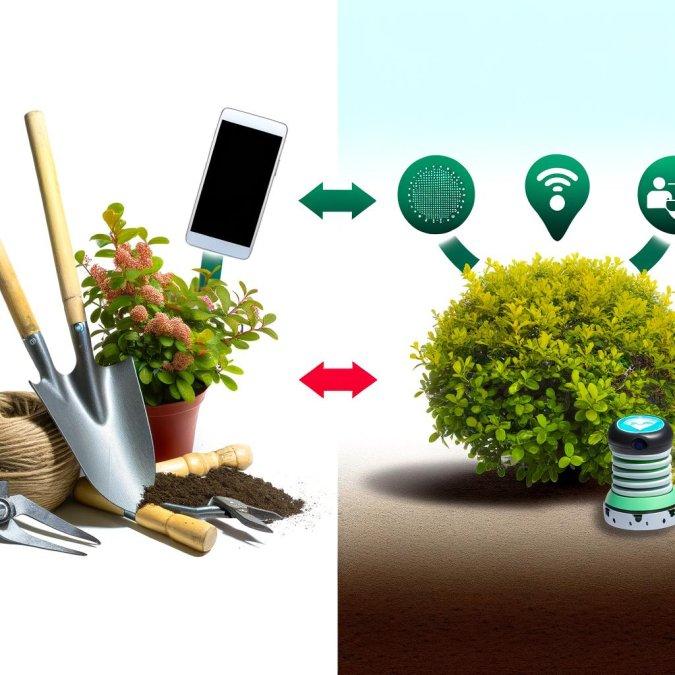
A gardener walks outside in the morning, presses a finger into the soil, looks at the leaves, checks the sky, and decides whether to water. In another garden, a phone notification reports that the root zone is still moist and the scheduled irrigation cycle has been paused.
These scenes may look like opposites, but they are built around the same question: what do the plants need today?
The evolution of gardening is not a story in which technology replaces experience. It is a gradual expansion of how gardeners observe conditions, record changes, repeat tasks, and respond when they cannot be physically present.
Remote monitoring extends a gardener’s awareness; it does not extend a sensor’s understanding beyond what that sensor can measure.
A moisture probe can report conditions near its sensing area. It cannot independently recognize a broken emitter across the bed, identify root disease, notice an insect beneath a leaf, or decide whether a plant is naturally entering dormancy.
The Tools Changed, but the Work Began With Observation
Gardeners have always used tools to make care more consistent. A watering can controls where water is delivered. A rain gauge records precipitation. A greenhouse vent changes temperature and airflow. Labels and notebooks preserve information that memory might lose.
Digital systems continue that same pattern. The major difference is that connected devices can collect information repeatedly, store it automatically, and make it available when the gardener is somewhere else.
Direct Observation and Hand Tools
Plant care depended on visiting the garden, touching the soil, recognizing changes in leaves, carrying water, removing weeds, adjusting supports, and responding to local weather.
This approach remains valuable because it keeps the gardener close to the plants. Its limitation is that conditions between visits can go unrecorded.
Written Records and Measured Conditions
Planting calendars, rainfall records, thermometers, soil tests, crop maps, and garden journals made decisions easier to compare across seasons.
The work was still manual, but observation became less dependent on memory. Gardeners could recognize recurring frost periods, watering problems, pest timing, and differences between growing areas.
Timers and Repeated Automation
Mechanical and electronic timers allowed lights, pumps, sprinklers, fans, and valves to operate without someone activating them each time.
This reduced repetitive labor but introduced a new weakness: a timer repeats its schedule even when rainfall, plant size, temperature, or soil moisture changes.
Sensors and Condition-Based Control
Moisture sensors, rain sensors, weather-based irrigation controllers, water-level indicators, flow meters, and environmental monitors allowed some decisions to respond to measured or estimated conditions.
The system could now skip, delay, warn, or adjust instead of following only the clock.
Remote Monitoring and Connected Records
Internet-connected controllers and monitoring platforms made readings, alerts, schedules, and equipment status available from another room, workplace, or location.
Remote access increased visibility, but it also created dependence on batteries, wireless signals, user accounts, software support, and correct notification settings.
Decision Support and Targeted Automation
Modern systems may combine weather information, sensor history, images, maps, equipment records, and programmed rules to recommend or perform a targeted response.
The strongest systems do not automate every task. They use information to focus attention where a meaningful change has occurred.
Traditional Knowledge Did Not Become Obsolete
A gardener still needs to understand the plants, growing medium, season, irrigation equipment, and local conditions. Technology can make a repeated observation easier, but it cannot turn an unsuitable plant, damaged irrigation system, or poorly designed growing space into a reliable one.
How Information Moves Through a Connected Garden
Remote monitoring can feel complicated because several pieces operate behind the visible application. Understanding the information chain makes it easier to identify where a failure may occur.
A sensor, controller, camera, meter, or weather source collects a value or event.
The reading moves through a cable, local hub, Wi-Fi network, radio signal, or cellular connection.
Software stores the information, compares it with a threshold, or displays it to the gardener.
A person or controller inspects, delays, activates, adjusts, records, or ignores the event.
A problem at any point can make the final information misleading. A properly functioning application may display an inaccurate moisture reading because the probe has poor soil contact. A correct reading may never reach the user because a battery died or the network disconnected. A valid alert may still lead to the wrong action if the threshold does not match the plant.
What Modern Garden Systems Can Monitor
Soil Moisture
Stationary probes can estimate water content or soil-water tension at a chosen location and depth. The information can support irrigation timing when the sensor represents the active root zone.
Readings are affected by placement, soil type, salinity, temperature, calibration, contact, and the area measured by the device.
Temperature and Humidity
Environmental sensors can reveal heat, cold, humidity, or condensation conditions that occur between garden visits.
They are especially useful in greenhouses, indoor gardens, propagation areas, and locations with rapid temperature changes.
Flow and Equipment Status
Flow meters, pressure information, valve reports, pump status, and water-level sensors can help reveal whether equipment operated as expected.
A flow change may suggest a leak, obstruction, empty reservoir, disconnected line, or operating difference that requires direct inspection.
Rainfall and Water Demand
Weather-based irrigation controllers use local weather information and programmed landscape conditions to adjust watering amount, timing, or frequency.
They estimate landscape demand rather than directly measuring moisture around every plant.
Images and Visual Records
Fixed cameras, mobile photographs, drones, and imaging systems can reveal canopy changes, discoloration, missing plants, weed patches, or equipment movement.
An image may identify an unusual pattern without confirming its biological cause.
Light and Growing Conditions
Light sensors, timers, water-temperature monitors, conductivity meters, and other devices can support indoor or controlled-environment growing.
The value depends on whether the reading is understood and connected to a practical care decision.
Monitoring is different from control. A device that reports dry soil may only send an alert. Another may communicate with an irrigation controller and prevent or allow a watering cycle. Product descriptions should be checked carefully so the gardener understands what the system actually does.
Manual Gardening and Connected Gardening Solve Different Problems
The connected approach is most valuable where conditions change between visits, where one person manages several growing zones, or where a missed event can cause serious damage.
The manual approach remains practical for small gardens that are inspected frequently, plants with simple care needs, and situations where technology would add more maintenance than useful information.
Data Becomes Useful Only When It Changes a Decision
A dashboard filled with charts may look advanced while providing little practical value. Before installing a sensor, decide what action its information should support.
If no clear response is connected to the information, the device may be collecting data without improving plant care.
Where Remote Monitoring Provides the Most Value
- Gardens with several irrigation zones: separate records can reveal which areas dry faster or behave differently.
- Greenhouses and propagation areas: temperature, humidity, water, and equipment conditions may change quickly outside normal visiting hours.
- Indoor hydroponic systems: water level, pump status, lighting, temperature, and maintenance reminders can reduce avoidable interruptions.
- Containers in exposed locations: small soil volumes may dry rapidly during hot or windy weather.
- Remote garden areas: alerts can direct attention before the next planned visit.
- Properties with water restrictions: suitable controllers can help keep irrigation within allowed days and changing landscape needs.
- Commercial or community growing spaces: shared records can improve communication between people responsible for different tasks.
- Frequent short absences: remote visibility can provide useful warning, although it does not replace arranging local help for serious problems.
Remote Access Introduces New Failure Points
A hand tool usually fails in a visible way. A connected system can appear normal while an unseen part of the information chain has stopped working.
- The sensor is positioned poorly. A probe near an emitter, container edge, downspout, low area, or unusual soil pocket may not represent the rest of the garden.
- The battery loses capacity. A device may report less frequently, disconnect, or stop without the plant-care problem being obvious.
- The network becomes unavailable. Remote information may disappear even though the local garden equipment continues operating.
- The threshold is unsuitable. Automation can consistently follow an incorrect moisture, temperature, or timing rule.
- The application notification is missed. Silent mode, expired permissions, account changes, or phone settings can prevent an alert from being noticed.
- A cloud service changes. Functions, subscriptions, compatibility, or software support may change during the useful life of the physical equipment.
- The equipment report is mistaken for plant health. A valve can operate normally while water coverage remains uneven.
- Manual and automated routines conflict. Additional hose watering may make sensor history appear inaccurate when the actual issue is unrecorded human activity.
- Too many alerts create fatigue. Frequent low-priority messages can make an important frost, leak, or pump alert easier to overlook.
Automation can make a good routine more consistent, but it can also repeat a bad routine more efficiently. Verify the garden itself, not only the screen.
The Right Level of Technology Depends on the Garden
Use Technology Selectively
A rain gauge, hose timer, moisture check, simple controller, and occasional photographs may provide enough information. Add connected equipment only when it solves a repeated problem.
Monitor Conditions Between Visits
Temperature, humidity, water level, irrigation, lighting, and pump alerts can protect plants in an environment where equipment and climate interact closely.
Organize Variation Across Space
Multiple sensors, mapped zones, imaging, flow records, equipment tracking, and targeted automation can help direct labor and inputs toward specific areas.
A small garden does not need to imitate a commercial farm. Likewise, a large greenhouse cannot usually rely on the same informal checking routine that works for a few containers beside a kitchen window.
Questions Worth Answering Before Buying Connected Equipment
Define whether the goal is watering accuracy, frost warning, pump monitoring, greenhouse ventilation, security, recordkeeping, or another specific task.
Moisture, temperature, weather, flow, water level, image changes, and equipment status are different types of information.
The location and depth should represent the plants and zone whose care will be influenced by the reading.
Confirm whether the device sends information, interrupts a schedule, operates equipment, or requires a separate compatible controller.
Determine whether the local schedule continues, whether manual controls remain available, and whether stored data can be recovered later.
Review battery type, sensor service life, cables, probes, hubs, pumps, subscriptions, and availability of replacement components.
Shared gardens and commercial spaces need clear responsibility for reviewing and acting on each type of notification.
Plan to compare readings with direct soil checks, separate instruments, equipment inspection, or another dependable observation.
Review account security, location data, camera access, cloud storage, privacy controls, and permissions for other household or team members.
Connected Gardens Still Need a Maintenance Routine
Keep the Physical and Digital Systems Aligned
Check for movement, poor soil contact, root growth, residue, shade changes, standing water, or physical damage.
Watch valves, pumps, sprinklers, lights, fans, and emitters operate instead of relying only on activity logs.
Plant size, root depth, sunlight, temperature, rainfall, and water use change during the growing cycle.
Confirm that important notifications still reach the correct device and person.
Replace or recharge components before the most demanding part of the season.
Hose watering, valve changes, pruning, repairs, and moved sensors can explain unexpected data.
Use strong credentials, review shared access, and keep account-recovery information current.
Know how to operate essential equipment safely when the application, hub, or internet connection is unavailable.
Adopt Technology Gradually
Installing an entire connected ecosystem at once can make troubleshooting difficult. A more useful approach is to begin with one recurring problem and observe whether the technology improves it.
A garden that repeatedly dries during short absences might begin with moisture monitoring. A greenhouse that experiences overnight temperature changes might begin with a dependable temperature alert. A lawn that follows the same schedule regardless of weather might benefit from a suitable weather-based or soil-moisture-based controller.
During the trial period:
- Collect a simple manual baseline before changing the routine.
- Install the device in a representative location.
- Compare readings with direct observations.
- Keep automatic actions conservative until reliability is understood.
- Record missed alerts, false alerts, disconnections, and manual overrides.
- Evaluate whether water, labor, plant losses, or response time actually improved.
- Expand the system only after the first use provides clear value.
This gradual approach keeps technology connected to a real gardening need rather than turning data collection into the goal itself.
What the Next Stage of Gardening May Look Like
Future gardening systems will likely combine more types of information. Soil conditions, weather, equipment performance, images, plant records, and previous outcomes may be analyzed together to direct inspections or adjust selected tasks.
More advanced systems may identify patterns that are difficult to notice during occasional visits. They may recognize that one area consistently dries faster, that a pump’s flow has gradually declined, or that a visual symptom appears after a particular environmental condition.
These capabilities can support faster and more precise decisions. They also make data quality, equipment compatibility, cybersecurity, repairability, and human oversight more important.
A recommendation produced from inaccurate sensors or incomplete records can still be wrong. A reliable future garden therefore needs both better technology and better habits for checking what the technology reports.
The evolution of gardening is best understood as an expansion of observation.
Hand tools extended physical ability. Written records extended memory. Timers extended repetition. Sensors extended measurement. Remote platforms extended visibility beyond the garden itself.
None of these tools removes the need to understand plants. The most successful systems combine direct observation with useful information, simple controls, repairable equipment, and a clear plan for what happens when a reading changes.
The goal is not a garden with the most devices. It is a garden where the right information reaches the right person early enough to protect plants, water, time, and effort.
Sources and Further Reading
- USDA National Institute of Food and Agriculture: Precision, Geospatial and Sensor Technologies
- USDA National Institute of Food and Agriculture: Agriculture Technology
- USDA National Institute of Food and Agriculture: Artificial Intelligence in Agricultural Systems
- University of Minnesota Extension: Soil Moisture Sensors for Irrigation Scheduling
- U.S. EPA WaterSense: Soil Moisture-Based Irrigation Controllers
- U.S. EPA WaterSense: Weather-Based Irrigation Controllers
- U.S. EPA WaterSense: Watering Tips

The BotaniQ Editorial Team writes and maintains practical guides about indoor gardening, smart irrigation, plant care, garden automation, and growing technology. Where relevant, articles reference official documentation, university extension resources, and other reputable sources. Content is updated when material information changes.